
Clarity, confidence, and a new approach to smile design. Meet Linda.
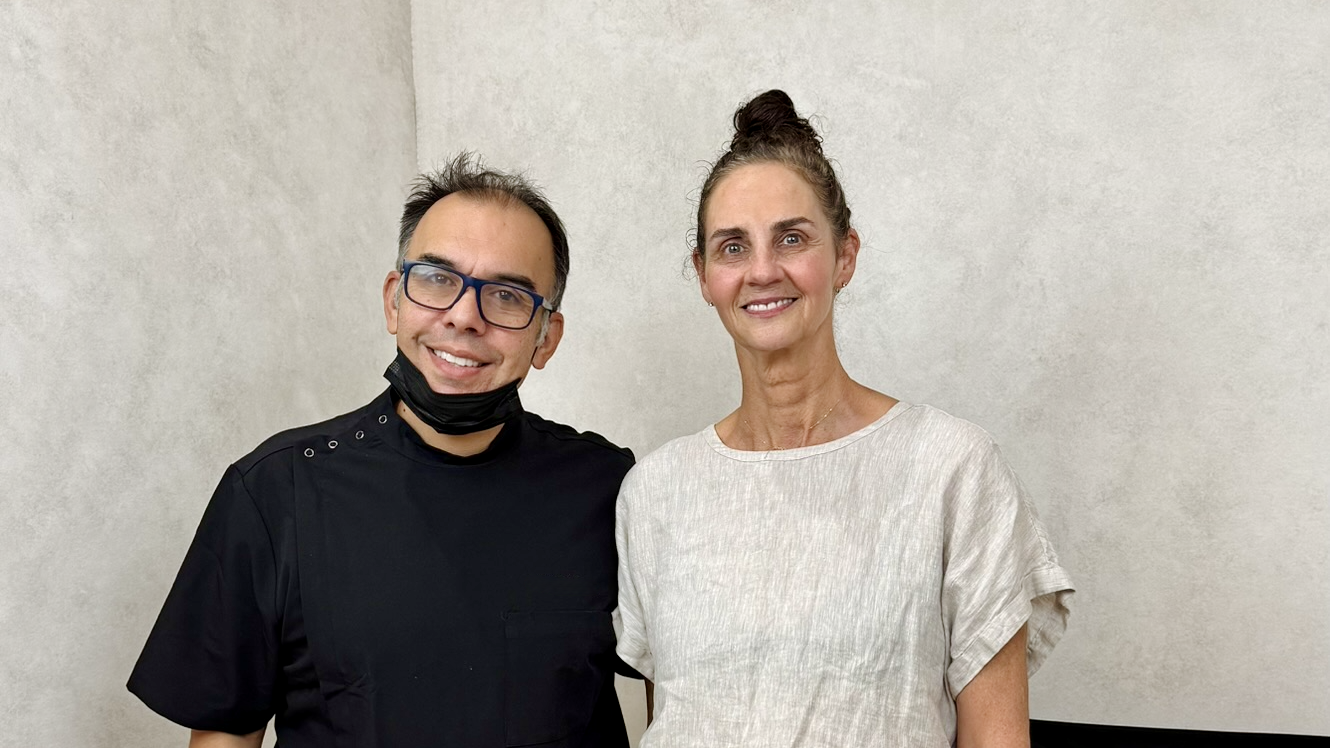
For most of her life, Linda learned how to smile without showing her teeth. It wasn’t that she lacked confidence in who she was, far from it.
She was social, engaged, present in the moments that mattered. But when it came to being photographed, or even laughing freely in a room full of people, there was always a quiet hesitation. “My midline was noticeably off to one side, and I was always aware of it,” she says. “Even when I was genuinely happy, there was this moment where I’d catch myself. I’d cover my mouth, or I just wouldn’t smile at all.”
Over time, it became instinct. There are few photos of Linda smiling, something she now reflects on with a mix of disbelief and acceptance. Even on her wedding day, she held back.
“I didn’t smile in my wedding photos. At the time, it felt normal. It was just what I did.”
It wasn’t something that stopped her from living her life, but it subtly shaped how she showed up in it. In social settings, weddings, parties, celebrations, she would find herself laughing, only to become suddenly self-conscious. “You’re in the moment, and then you think, are people looking at my teeth? They probably weren’t, but it didn’t matter. That feeling was always there.”
A decade earlier, Linda had explored the idea of treatment. But the options presented to her felt overwhelming and uncertain. “I was told it would be complicated, expensive, around $20,000, and even then, they couldn’t guarantee the result I wanted. It just felt too hard. So I let it go.” And for years, that’s where it stayed, something she thought about, but never truly believed was possible. But what changed was not just access to treatment, but access to clarity.
When Linda was introduced to a new approach through Dr John and his team, the experience felt fundamentally different from anything she had encountered before. It wasn’t simply a consultation, it was a fully mapped-out vision of what her smile could become, grounded in data, technology, and clinical expertise.
“The first thing I noticed was that they listened,” she says. “They understood what I wanted. And then they showed me what could actually be achieved.”
Using advanced digital planning technology, Linda was able to see a personalised, visual simulation of her future smile, something she had never been offered before. It was not a generic promise, but a tailored projection based on her anatomy, her goals, and the clinical pathway required to get there. For the first time, Linda wasn’t imagining a better smile, she was looking at it.
“I remember seeing it on the screen and thinking, wow. I nearly cried. I didn’t think it could look that good. I didn’t think that could be me.” That moment proved pivotal. It wasn’t just emotional, it was clarifying. “It gave me confidence to move forward. It’s a big decision, and you want to know what you’re working towards. Without that level of clarity, I don’t think I would have gone ahead.”
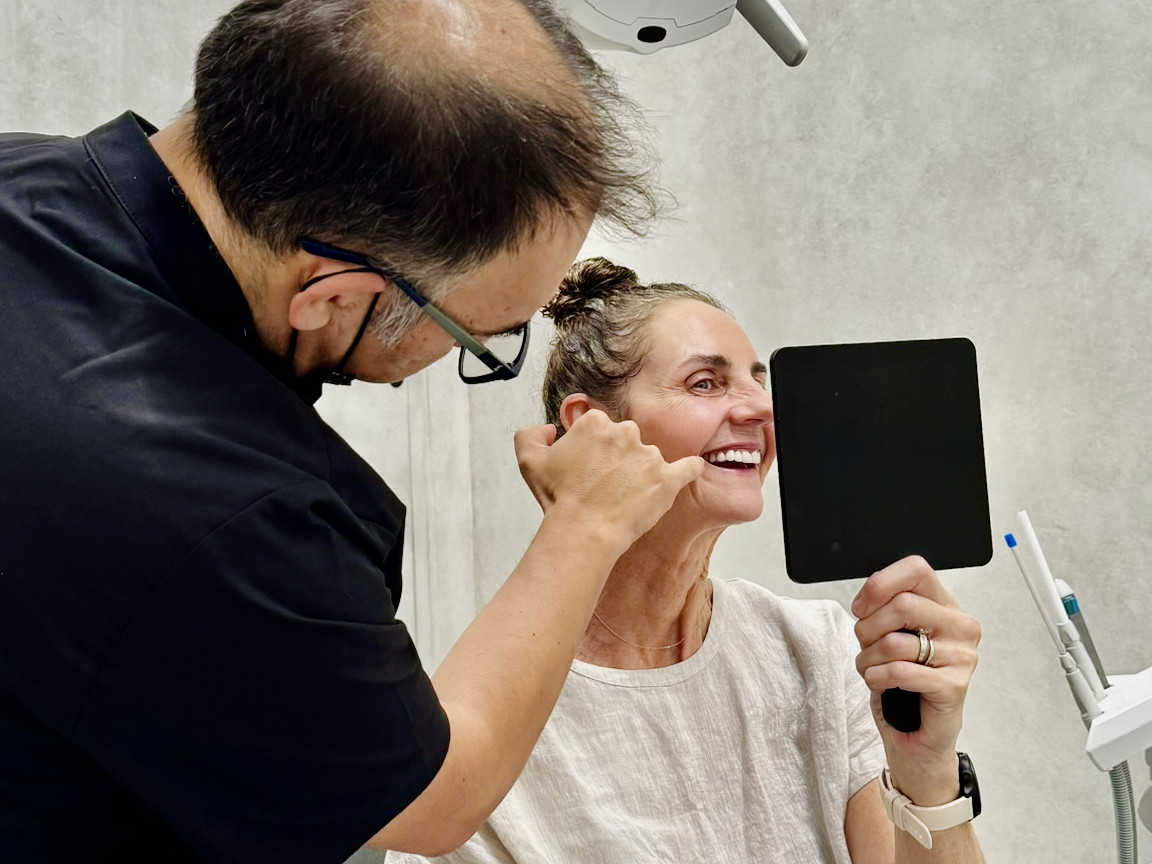
Dr John Hagiliassis performs Linda’s final consult ahead of the conclusion of her complex case.
This new model of care is built on removing uncertainty, combining advanced imaging, treatment simulation, and clinician-led planning to create a clear, structured pathway from day one. For patients like Linda, who had previously been told their case was too complex, this level of precision changes the decision entirely. From the outset, the process was framed not as a quick fix, but as a carefully managed journey, one that would take time, consistency, and trust between patient and clinician.
“They were very honest about that. It wasn’t about perfection overnight. But I was completely fine with it, because anything was going to be better than where I started.”
Throughout her treatment, monitoring tools played a key role in keeping Linda on track. Through simple, app-based check-ins, her progress was continuously reviewed by Dr John and his team, allowing adjustments to be made in real time without unnecessary disruption.
“If I ever had a question, they were there. If something came up, they made time. I always knew where I was at and what the next step was. That made a big difference.”
This combination of technology and accessibility created a treatment experience that felt both highly advanced and deeply personal. Linda describes it as seamless, responsive, and reassuring, even as her case evolved. Her treatment ultimately extended beyond the original timeline. What was initially expected to take around 18 months stretched closer to three years, largely due to the complexity of her case and the natural resistance of one particular tooth. “It just didn’t want to move,” she says with a laugh. “But that’s just biology. Everyone’s different. It didn’t frustrate me, because I knew we were working towards the right result.”
Importantly, the extended timeline was not a result of uncertainty or poor planning, but of refinement. This approach allows for ongoing optimisation, making small, precise adjustments to ensure the final outcome aligns as closely as possible with the original vision. Throughout the process, her commitment never wavered. The end goal was clear, and for the first time, it felt attainable.
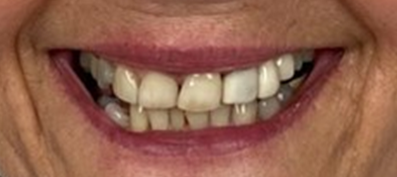
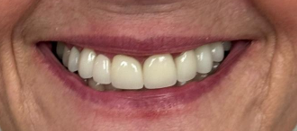
Today, Linda’s relationship with her smile has completely transformed. “I love it. That’s the simplest way to put it,” she says. “But more than that, I don’t think about it anymore. I just smile.” It’s a subtle shift, but a profound one. The self-awareness that once defined those moments has disappeared:
“You can see it in photos now. I’m relaxed. I’m happy. I’m not holding anything back. That’s a really big change.”
The reactions from others have been telling, not because they point out the treatment, but because they often don’t. “People say I look different, but they can’t always tell why. They just say I look great, or that my smile looks really natural. That’s exactly what I wanted.”
For Linda, the impact has gone beyond aesthetics. It is not just about straighter teeth, but about the removal of a lifelong hesitation. “I’ve always been a confident person, but this gave me another level of confidence. I feel more comfortable expressing myself fully. There’s nothing I’m trying to hide anymore.”
Perhaps most striking is that Linda began this journey later in life, something she now sees not as a limitation, but as a reminder of what is possible when the right approach is available. “I used to think, what’s the point at my age? But now I realise, it was something I did for me. And I wish I had done it sooner.” Looking back, there’s no ambiguity in how she feels about the decision. “It was worth everything. Not just for how it looks, but for how it makes you feel.”
Her story reflects a broader shift in modern dentistry, where outcomes are no longer left to uncertainty, and patients are no longer asked to commit without clarity. Through a combination of technology, structured planning, and clinician expertise, a new standard of care is emerging, especially for those who were once told their cases were too complex.
And for those still unsure, Linda’s advice is simple:
“If it’s something you’ve been thinking about, don’t wait. Once you can see what’s possible, everything changes.”